

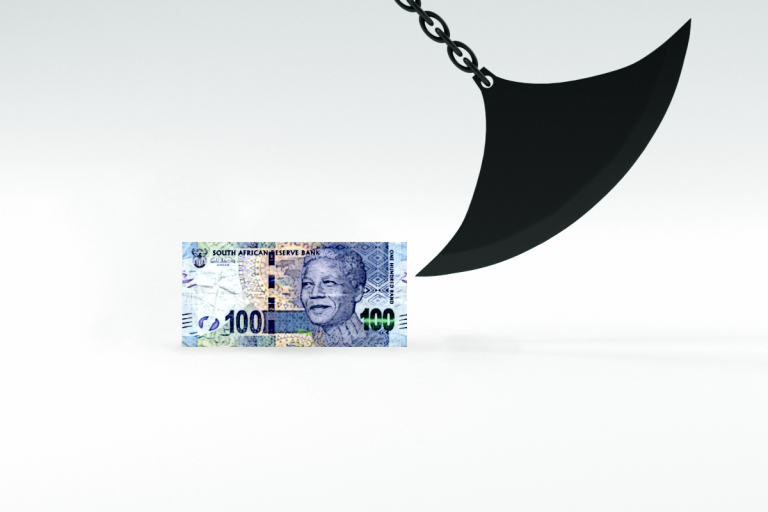
Six major shocks over the past three years have cost South Africa’s economy as much as R850 billion, according to estimates from the Department of Trade, Industry, and Competition.
Trade, Industry and Competition Minister Ebrahim Patel revealed that the economy was severely impacted by two global and four local crises that occurred in quick succession between early 2020 and the third quarter of 2023.
At the release of his department’s Industrial Policy & Strategy Review report, Patel said the cumulative output lost to the South African economy is estimated between R650 billion and R850 billion.
The six shocks listed were:
1. The global Covid-19 pandemic
2. The July 2021 civil unrest — the worst since apartheid
3. The war in Ukraine
4. Severe flooding in KwaZulu-Natal in 2022
5. Load shedding
6. Logistics constraints
According to the report, these crises disrupted South Africa’s economic recovery following the era of state capture during former President Jacob Zuma’s administration, which heavily affected state-owned enterprises such as Eskom and Transnet.
The shocks delayed and altered the direction of the country’s industrial policy. The report noted that without these disruptions — and assuming South Africa had maintained the same growth trend as in the decade prior to the pandemic — the nation’s gross domestic product (GDP) would have been between 3% and 5% larger in real terms than it currently is.
Since 2020, South Africa’s average economic growth rate has been 0.5%.
The South African Reserve Bank’s (SARB) Monetary Policy Review for April stated that while load shedding is expected to ease gradually over the next three years, it will continue to hamper economic growth. The Reserve Bank’s projections assume that load shedding will persist for all but 38 of the remaining 238 days of 2024.
In 2023, South Africa’s GDP grew by just 0.6%, which the SARB described as insufficient for a country with a growing population and labour force. However, the Bank forecasts a gradual improvement in growth as electricity supply stabilizes, driven by private investment in renewable energy and increased maintenance efforts by Eskom.
“Although the full implementation of the energy and logistics sector reforms will ease the performance challenges in these network industries, inadequate electricity supply and logistical bottlenecks are expected to remain a drag on the economy,” the SARB stated.
The Reserve Bank projects real GDP growth to improve to 1.2% in 2024 and rise to 1.6% by 2026.
Despite these gains, growth rates would remain below South Africa’s long-term average of 2% and significantly lower than the 4.1% projected for emerging markets this year by the International Monetary Fund (IMF).
“In the near term, uncertainty around the reliability of electricity supply persists as the grid remains fragile amid still-elevated unplanned outages, as evidenced by the occasional bouts of Stage 6 load shedding earlier this year,” the SARB warned.
