

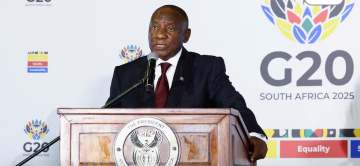
A coalition of 165 civil society organizations has criticized South Africa for what they describe as a lack of progress on addressing global debt sustainability issues during its presidency of the G20 major economies.
In a letter sent to South African President Cyril Ramaphosa on Monday — coinciding with the opening of the International Monetary Fund (IMF) and World Bank annual meetings in Washington — the groups urged South Africa to push for debt relief reforms before handing over the G20 leadership to the United States on December 1.
The organizations, including Amnesty International, ActionAid International, the Malala Fund, and the European Network on Debt and Development (Eurodad), called for the “cancellation of all unsustainable and illegitimate debts” to allow developing countries to prioritize education, healthcare, gender equality, and climate resilience.
They also demanded that the G20 support the creation of an African Credit Rating Agency, establish a “Borrowers Club” for debt coordination among developing nations, and consider selling IMF gold reserves to fund global debt relief initiatives.
“Despite some progress under the G20’s Common Framework, current debt arrangements remain inadequate,” the letter stated. “Restructuring processes are too slow, debt reductions too shallow, and the sharing of responsibility between public and private creditors deeply unequal.”
The signatories commended Ramaphosa’s commitment to making debt sustainability one of the main focuses of South Africa’s presidency but lamented that “so far, nothing tangible — let alone ambitious — has been achieved.”
“While this year’s G20 has been presented as an ‘African G20,’ there is no evidence that progress has been made on the debt crisis facing Africa and other developing regions,” the groups added.
The World Bank has reported that nearly half of 150 developing countries are already in or nearing debt distress, as total debt in emerging markets surged by $3.4 trillion in the second quarter of 2025 to a record $109 trillion.
The letter also highlighted that African nations face disproportionately high borrowing costs compared to countries with similar credit profiles elsewhere, costing the continent an estimated $74.5 billion annually in excess interest payments.
Failure to implement decisive debt reductions, the groups warned, could jeopardize global efforts to combat climate change.
The United States is set to assume the G20 presidency on December 1, with U.S. Vice President JD Vance expected to represent Washington at the upcoming leaders’ summit.
