
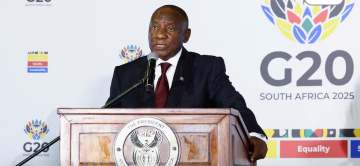
With just over a week to go before the G20 Summit in Johannesburg on 22 and 23 November, several key world leaders have confirmed they will not attend, raising concerns about whether the summit will be able to issue a Leaders’ Declaration.
US President Donald Trump has announced that no US government officials will attend, citing claims of violence against Afrikaners and illegal farm confiscations—claims widely regarded as false. Argentine President Javier Milei and Mexican President Claudia Sheinbaum Pardo have also confirmed they will not attend. There are unconfirmed reports that Chinese President Xi Jinping may skip the summit for unknown reasons, while Russian President Vladimir Putin is unable to attend due to an ICC arrest warrant. Russian Foreign Minister Sergey Lavrov will also not be present, with Russia’s delegation to be led by deputy chief of staff Maxim Oreshkin.
Despite these absences, 65 delegations are expected at the Johannesburg Expo Centre, including representatives from the remaining G20 countries, the European Union, African Union, 15 guest countries, regional African economic communities, and international organisations.
President Cyril Ramaphosa expressed confidence that the US boycott would not prevent the summit from proceeding or making key decisions. However, other G20 members emphasised that consensus is crucial for the adoption of the Leaders’ Declaration, which could be jeopardised by the US absence.
South Africa’s draft declaration, under the theme of solidarity, equality, and sustainability, outlines commitments on climate change, gender equality, free trade, the Sustainable Development Goals, critical minerals, debt sustainability, and financing for just energy transitions. Analysts say the Trump administration, along with Argentina and Saudi Arabia, may challenge some of these development-oriented positions.
South African officials have previously noted that ministerial-level declarations were adopted in the US absence, but the leaders’ summit presents a unique challenge, as all members are expected to agree by consensus. Some members have suggested that Trump’s boycott may indicate an intent to narrow the summit’s agenda, focusing on economic issues while sidelining development initiatives.
The summit will also discuss South Africa’s four key priorities under its G20 presidency: strengthening disaster resilience, ensuring debt sustainability for low-income countries, mobilising finance for a just energy transition, and harnessing critical minerals for inclusive and sustainable growth.
The G20 sherpas are scheduled to meet on Sunday to finalise the text of the declaration and assess the impact of the US and other leaders’ absences on consensus.
