

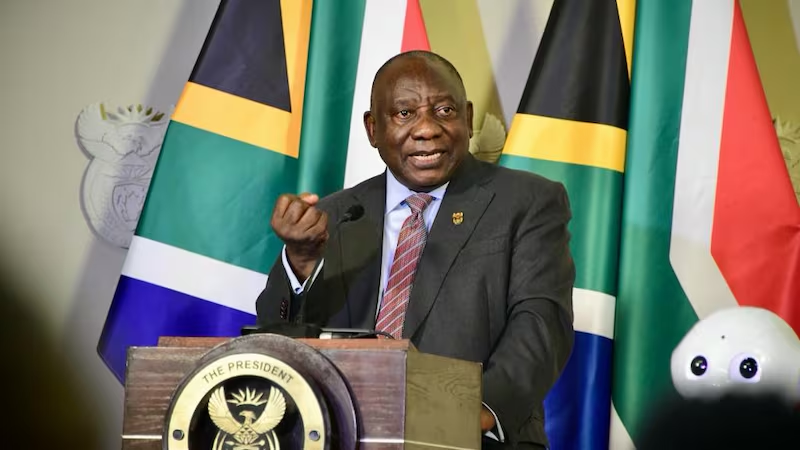
President Cyril Ramaphosa has commended Statistics South Africa (Stats SA) for what he described as an exceptional effort in compiling the Census 2022 report, urging all sectors of society to use the data to improve service delivery across the country.
Speaking during the official handover of the Census 2022 national results at the Union Buildings in Pretoria on Tuesday, Ramaphosa emphasised that census data is a vital tool for planning, policymaking, and development.
“It informs the planning, budgeting, and policy-making work of government at the most fundamental level. We have long said that one of our priorities in building a capable, ethical, developmental state is to ensure that policymaking is evidence-driven,” he said.
Ramaphosa warned that policies not guided by accurate data could lead to inefficiencies in resource allocation, underestimation of citizens’ needs, poorly planned programmes, and weak financial management.
Statistician-General Risenga Maluleke revealed that South Africa’s population has grown from 51.7 million in 2011 to more than 62 million in 2022. Females make up 51.5% of the total population, while males account for 48.5%.
Gauteng and KwaZulu-Natal remain the country’s most populous provinces, with 15 million and 12.4 million residents respectively. The Northern Cape has the smallest population at 1.3 million.
In terms of racial composition, black Africans make up 81.4% of the population, followed by coloureds at 8.2%. The white population declined from 8.9% in 2011 to 7.3% in 2022, while Indians/Asians slightly increased from 2.5% to 2.7% over the same period.
Ramaphosa praised Stats SA for completing the massive task despite major challenges, including the Covid-19 pandemic, local government elections, the July 2021 unrest, and floods in two major provinces.
“Having decided in 2018 to develop multiple data-collection methods, including computer-assisted telephonic interviews and online self-enumeration options, Stats SA introduced complete digitisation of the entire census process,” he said.
The president noted that South Africans’ growing familiarity with the digital age helped Stats SA complete the exercise just four months after the original October 2021 deadline.
Ramaphosa described Census 2022 as South Africa’s first-ever fully digital census, calling it one of the most complex and extensive undertakings in the country’s history.
“It involves years of preparation and planning. Enumerators had to traverse the country counting people in households, hospitals, prisons, and even among the homeless and those in transit at our borders,” he said.
He urged South Africans to have full confidence in the data, commending Stats SA for maintaining credibility and integrity while adhering to international best practices.
“There will be doubters who will question your information and methods, but only you, as the Statistician-General, are the custodian of official statistics in the country,” Ramaphosa added.
He stressed that the Census 2022 results will help the government implement its programmes in a targeted, evidence-driven manner.
“Despite load-shedding, which we are urgently addressing, we should be encouraged by the almost universal access to electricity,” he said. “The results presented today underscore the urgency with which we must work toward the aspirations of the National Development Plan and the UN Sustainable Development Goals.”
Ramaphosa concluded that the statistics would serve as an invaluable tool in addressing South Africa’s social and economic challenges.
