

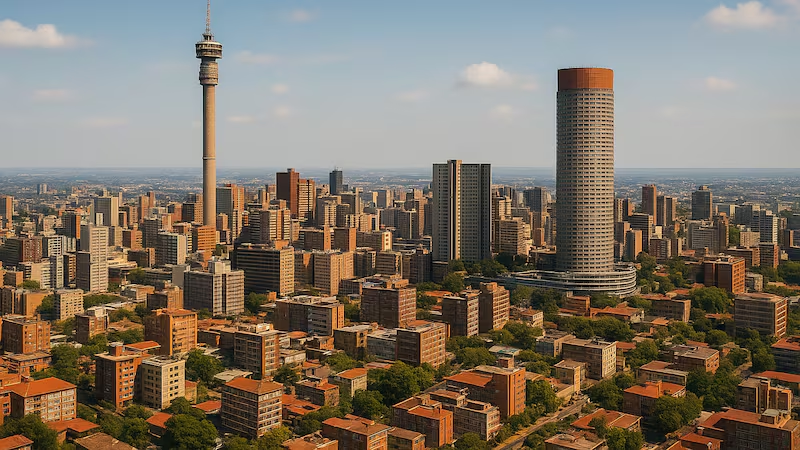
Johannesburg has retained its position as Africa’s wealthiest city, according to the Africa Wealth Report 2025, which also predicts that the continent’s millionaire population will grow by 65% over the next decade.
The report, compiled by international wealth advisory firm Henley & Partners in partnership with New World Wealth, shows that Africa is home to 25 billionaires, 348 centimillionaires (those with $100 million or more), and 122,500 millionaires.
Sub-Saharan Africa’s economy is expected to grow by 3.7% in 2025, outpacing the US at 1.4% and Europe at 0.7%, and projected growth for 2026 is 4.1%. Dominic Volek, group head of private clients at Henley & Partners, said Africa’s expanding high-net-worth population positions the continent as a key player in global wealth markets.
South Africa remains the dominant force, accounting for 34% of Africa’s millionaires, equal to the combined total of the next five wealthiest countries: Egypt, Morocco, Nigeria, Kenya, and Mauritius. South Africa has 41,100 millionaires, leading the “Big Five” wealth markets.
Johannesburg leads at a city level with 11,700 millionaires concentrated in Sandton and the Waterfall–Midrand corridor. Cape Town ranks second with 8,500 millionaires and is home to 35 centimillionaires. It also has Africa’s most expensive prime real estate market at US$5,800 (R101,762) per square metre and is expected to surpass Johannesburg in total wealth by 2030.
Cairo comes third with 6,800 millionaires, while Nairobi ranks fourth with 4,200. Mauritius has recorded the fastest growth in millionaire numbers over the past decade (+63%), followed by Rwanda (+48%) and Morocco (+40%), while Nigeria saw a 47% decline.
Henley & Partners’ research indicates that affluent Africans are increasingly pursuing global mobility strategies, acquiring residence rights or second citizenships abroad for business opportunities, education, and wealth protection. Portugal’s Golden Visa programme and Caribbean citizenship options in Grenada and Antigua and Barbuda are the most popular choices.
Experts note that Africa’s wealth growth comes with challenges. Chief economist Jean Paul Fabri said the rising millionaire class is a signal of opportunity but also a test of the continent’s ability to convert private wealth into broad-based economic transformation.
Political analyst Justice Malala emphasized the dualities in Africa’s economic story. “Its economic trajectory reveals resilience and promise, yet exists alongside deep political fractures and governance setbacks,” he said.
With Africa’s young population, particularly women in rural areas, playing a critical role in sectors such as agriculture, the potential for economic transformation remains significant, experts said.
For Africa, the aim is not just to count millionaires but to build a wealth ecosystem where prosperity is self-reinforcing.
