

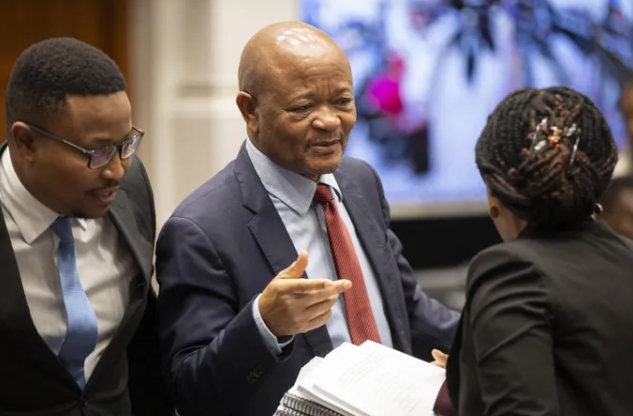
Suspended Police Minister Senzo Mchunu has revealed that President Cyril Ramaphosa was informed and agreed with his decision to disband the Political Killings Task Team (PKTT).
Speaking before the South African Police Service (SAPS) Ad Hoc Committee investigating allegations of corruption and political interference, Mchunu said he personally briefed the president on the matter.
During Friday’s hearing, the minister faced intense questioning about his role in dissolving the task team, a decision that came under scrutiny after KwaZulu-Natal Police Commissioner Lieutenant General Nhlanhla Mkhwanazi accused him of interfering in police operations.
Asked by Evidence Leader Advocate Norman Arendse whether he had notified Ramaphosa before disbanding the PKTT, Mchunu confirmed that he had done so.
When committee member Julius Malema pressed him further, asking if Ramaphosa agreed with the move, Mchunu replied, “The answer in the affidavit is that I briefed the president; he agreed with the briefing I gave him.”
Mchunu told the committee that he met with Ramaphosa either in January or February this year, following his decision made in December to dissolve the task team.
“I sought an appointment and it was granted. I went to present that I had made this decision. I don’t recall the exact date, but I am prepared to check,” he said.
The suspended minister said the briefing was aimed at pre-empting potential political tensions surrounding the task team. “I told him these matters, among others, led me to disband the political task team. If I had not acted then, there might have been calls for a commission of inquiry on those matters. So I decided to pre-empt such a call.”
Mchunu defended his decision, stating it was part of routine administrative processes, noting that similar directives had been issued in the past. “I have issued similar directives before, including the disbandment of the police inspectorate,” he said.
Earlier, the committee heard about Mchunu’s tense relationship with Mkhwanazi. Mchunu said he had advised his chief of staff, Cedrick Nkabinde, to record conversations with the KZN police commissioner after sensing threats of retaliation over the PKTT’s dissolution.
Evidence leader Arendse questioned Mchunu about his refusal to meet Mkhwanazi, who had sought discussions on urgent policing matters. “I wanted to meet General Mkhwanazi privately, but it just did not happen,” Mchunu explained.
He added that a WhatsApp voice recording between Nkabinde and Mkhwanazi contained threats suggesting the commissioner would “fight back,” which influenced his decision.
“I was of sober mind when I issued the directive to disband the task team,” Mchunu insisted.
Responding to further questions about the letter officially disbanding the PKTT, Mchunu confirmed he personally drafted it on New Year’s Eve. “I don’t want to leave any doubt about who wrote the letter and why. I therefore take full responsibility. I can assure you that I was sober when I wrote that letter,” he said.
