

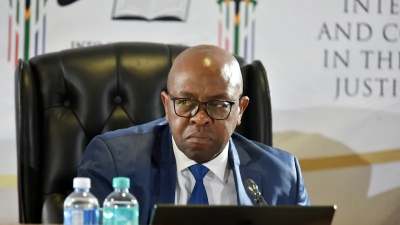
The Madlanga commission of inquiry will this week hear evidence partially in camera from three detectives who investigated crimes linked to criminal cartels, the main focus of the commission’s investigations. Their testimonies are expected to reveal alleged interference in their work.
According to the commission, the detectives, referred to as witnesses A, B, and C, will testify off camera from a remote location, though their voices will be audible to the public.
The commission is investigating allegations of criminality, corruption, and political interference within South Africa’s justice system.
The public and media will be allowed access to the auditorium at the Brigitte Mabandla Justice College in Pretoria, where the hearings will take place. The proceedings will be livestreamed, and the witnesses’ exhibits will be displayed live on screen during their testimony.
Transcripts of the witnesses’ testimonies will be made available to the public after they have completed their appearances.
Last week, Justice Mbuyiseli Madlanga ruled that the commission would sit in camera due to the sensitivity of the evidence, as one witness had testified about matters still under active police investigation.
Earlier, the commission allowed another witness, referred to as X, to testify remotely and off camera with the help of a mediator. However, this arrangement was later changed after the commission identified a potential risk, leading one of the evidence leaders to read the witness statement instead.
Witness X’s evidence connected parts of the testimony previously presented by suspended crime intelligence boss Lt-Gen Dumusani Khumalo regarding a beneficial relationship between the head of the Directorate for Priority Crime Investigation in KwaZulu-Natal, Maj-Gen Lesetja Sesona, his son, and criminal accused Vusimuzi “Cat” Katlego Matlala.
The evidence included an analysis of chat messages between Matlala and senior figures within the SA Police Service, revealing how he allegedly benefited from confidential institutional information and other internal police data.
