

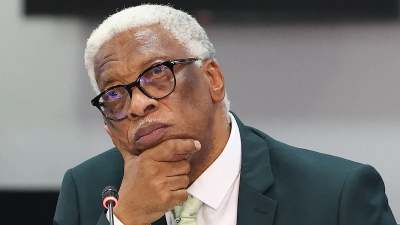
Eastern Cape Judge President Selby Mbenenge’s version before the judicial conduct tribunal investigating a sexual harassment complaint against him has been described as “riddled with improbabilities, evasions, and contradictions” by evidence leader Salome Scheepers.
Scheepers made the remarks on Tuesday during her closing arguments at the tribunal, which is hearing the first-ever sexual harassment case against a sitting judge in South Africa. She urged the tribunal to find Mbenenge guilty of gross misconduct, stating that the allegations struck at the heart of “equality in the workplace.”
If found guilty and the Judicial Service Commission agrees, Mbenenge could face impeachment.
Scheepers said the complainant, Mbenenge’s secretary, Andiswa Mengo, had her testimony corroborated by WhatsApp messages presented before the tribunal. The messages, she said, showed that Mbenenge initiated most of the sexually suggestive conversations, ignored Mengo’s attempts to disengage, and sent unsolicited sexual images. Several witnesses also supported Mengo’s account, Scheepers argued.
In contrast, Scheepers said Mbenenge’s version was contradictory and lacked credibility. “There is no evidence here of mutuality, no evidence of reciprocal affection,” she said.
However, Mbenenge’s counsel, advocate Muzi Sikhakhane (SC), argued there was no “one iota” of evidence to support the complaint. He said the case hinged on three issues: the WhatsApp exchanges, disputed images allegedly sent by Mbenenge, and an alleged incident in his chambers where Mengo claimed he pointed to a bulge in his trousers and made an inappropriate comment.
Sikhakhane said there was no proof that the chamber incident occurred or that the images were sent by Mbenenge. “The commission is being asked to make findings based on conjecture,” he warned, calling it a “dangerous path.”
Scheepers countered that Mengo’s testimony itself was evidence and that none of the witnesses contradicted her version. Counsel for Mengo, advocate Nasreen Rajab-Budlender (SC), argued that even without findings on the chamber incident or the disputed images, Mbenenge’s admitted conduct was sufficient to establish sexual harassment.
“On his own version, he admitted to badgering her and persisting in sexual conversations and requests for photographs,” Rajab-Budlender said. “In circumstances where he is a leader of the judiciary, this conduct is inconsistent with what is expected of a judge president.”
Rajab-Budlender said Mengo testified that she felt compelled to respond to Mbenenge’s messages due to his position of authority. She described his conduct as “unwanted, persistent, and of a sexual nature.”
Citing the definition of sexual harassment, Rajab-Budlender said Mbenenge’s actions clearly met the criteria. She identified 13 instances in the text messages where Mengo declined or resisted his advances, either by saying “no” or using phrases like “it is impossible.”
Scheepers added that even messages that seemed consensual might have been influenced by fear, intimidation, or pressure resulting from the power imbalance between the two. She said gender expert Lisa Vetten’s testimony supported this view, noting that Mengo’s responses were typical of someone “attempting to preserve her safety, dignity, and livelihood within a profoundly unequal relationship.”
Sikhakhane, however, argued that the conversations showed “two willing adults.” He said claims of unwantedness were “a creative reconstruction” of their exchanges. “Persistence alone does not constitute sexual harassment—it must be unwelcome,” he said, adding that unequal power only became problematic if abused.
“It is not for the tribunal to decide how flirting should be done,” Sikhakhane said. “If you are called upon to decide that flirting is dishonourable, well, we plead guilty.”
Tribunal chairperson, retired Gauteng Judge President Bernard Ngoepe, said the case would be decided strictly on the facts and the law. He added that public opinion would have no bearing on the tribunal’s findings and that the decision would take some time to be delivered.
